
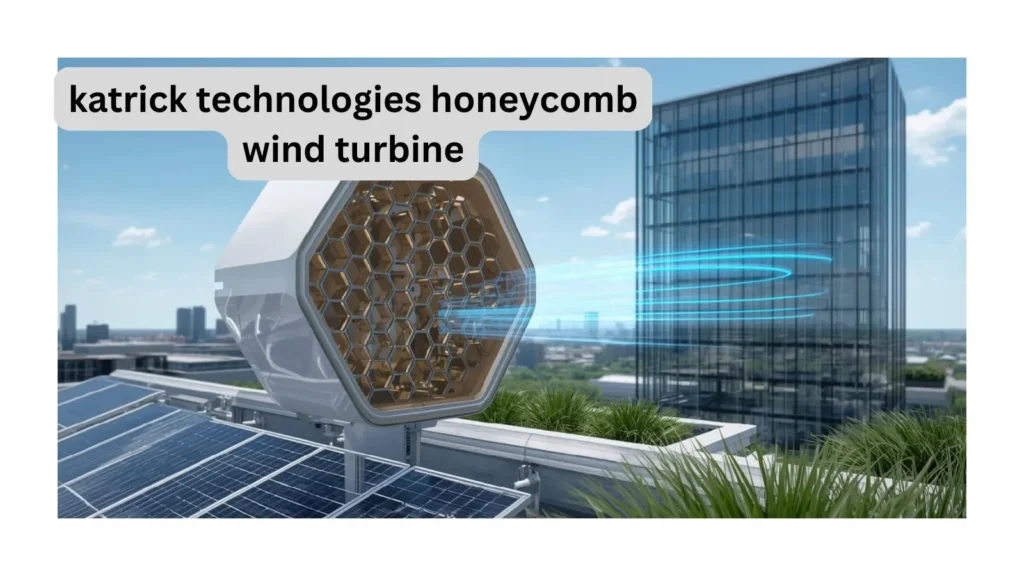
The Katrick Technologies honeycomb wind turbine marks a paradigm change in sustainable energy collection. Unlike standard wind turbines, which have large rotating blades, this unique design has a honeycomb construction with many small oscillating panels that catch wind energy from all directions.
People look for this technology because they want alternatives to traditional wind power, particularly ones that work in urban areas, make less noise, and do not require the large open expanses that traditional turbines do. If you’ve heard about Katrick’s honeycomb design and wondered how it works, if it’s more efficient than traditional turbines, or whether it might power city houses and businesses, you’re not alone. This ambiguity derives from insufficient public coverage and a significant deviation from established wind energy technology.
Katrick Technologies Honeycomb Wind Turbine – Quick Answer
The Katrick Technologies honeycomb wind turbine is a patented wind energy system that uses a honeycomb-patterned structure containing multiple small aerofoils (panels) instead of large rotating blades. These panels oscillate (move back and forth) when wind passes through them, converting kinetic energy into electricity through generators attached to each panel.
Key features:
- Works with wind from any direction (omnidirectional)
- Captures low-speed winds (as low as 2-3 m/s)
- Quieter than traditional turbines
- Scalable and modular design
- Can be installed on buildings, highways, and infrastructure
Example: Imagine a wall of hexagonal cells (like a beehive) where each cell contains a small flapping panel. When wind blows, hundreds of these panels flutter simultaneously, generating cumulative electricity—similar to how solar panels work in arrays but for wind energy.
Overview of Katrick Technologies Honeycomb Wind Turbine
This section introduces Katrick Technologies as an innovator in wind energy. It explains what a honeycomb wind turbine is and why this design represents a shift from traditional horizontal-axis and vertical-axis turbines. It establishes context for readers searching for the Katrick wind turbine and new-generation distributed wind solutions.
The section also clarifies the core value proposition. It explains how the honeycomb structure improves airflow capture, safety, and scalability. Readers gain a clear baseline understanding before moving into technical or commercial details.
How the Honeycomb Wind Turbine Technology Works
This section explains the honeycomb turbine architecture in simple terms. It covers airflow channeling, modular cells, and how the design captures wind efficiently at lower speeds. The explanation focuses on structural logic rather than abstract theory.
The second part highlights performance advantages. It explains why the technology suits urban environments, rooftops, low-wind regions, and distributed energy systems, where conventional turbines often fail or underperform.
Katrick Technologies Honeycomb Wind Turbine Reviews and Performance Insights
This section addresses real-world interest by summarizing available reviews, pilot project insights, and early performance data. It explains what engineers, researchers, and energy professionals say about durability, output stability, and maintenance expectations.
It also manages expectations. Instead of hype, it explains how emerging technologies are evaluated, what metrics matter, and how performance claims should be interpreted when commercial-scale deployments are still developing.
Katrick Technologies Honeycomb Wind Turbine Price Breakdown
This section explains that pricing depends on turbine size, deployment scale, installation complexity, and system integration. It avoids fixed numbers when unavailable while still providing realistic cost drivers.
The second paragraph compares honeycomb turbines with traditional small wind systems. It explains where upfront costs may differ and where long-term value could offset initial investment through efficiency and reduced maintenance.
Honeycomb Wind Turbine for Sale – Availability and Buying Options
This section clarifies current commercial availability. It explains whether the Katrick honeycomb wind turbine is available for direct sale, limited to pilot programs, or offered through partnerships and project-based deployments.
It also defines the ideal buyer profile. This includes municipalities, commercial buildings, campuses, clean energy developers, and organizations exploring distributed wind generation rather than residential hobbyist use.
Markets, Portfolios, and Grid Forecast Models Supporting Wind Assets
This section connects honeycomb wind turbines to the broader energy market ecosystem. It explains how modern wind assets rely on forecasting models to participate in energy markets and balance supply with demand.
The second paragraph explains how distributed wind assets fit into portfolios. It shows how innovative turbines can complement solar, storage, and traditional wind assets to improve grid resilience and revenue predictability.
Trusted Globally by the Renewable Energy Industry
This section focuses on credibility and trust signals. It highlights research validation, academic involvement, innovation awards, and alignment with global renewable energy standards.
The second paragraph explains why trust matters for new wind technologies. It shows how institutional backing and scientific rigor reduce adoption risk for utilities, investors, and infrastructure partners.
Complete End-to-End Generation Insight for Wind Assets
This section explains how performance does not end with hardware. It covers monitoring, analytics, and operational insight that help optimize energy output over time.
The second paragraph connects generation insight to decision-making. It explains how data-driven visibility improves maintenance planning, financial forecasting, and long-term asset performance for honeycomb wind systems.
Data and Forecasting Models Used for Wind Energy Optimization
This section explains how Historical Time Series data, Typical Meteorological Year (TMY) datasets, and live and forecast wind data are used to model energy yield accurately.
The second paragraph shows practical benefits. It explains how these models support grid compliance, reduce uncertainty, and improve investor confidence when deploying newer turbine designs like the honeycomb wind turbine.
Moreover, the term “honeycomb wind turbine” wasn’t coined by accident. In fact, the design literally mimics a honeycomb structure—the hexagonal pattern found in beehives. This form of biomimicry (copying nature’s designs) allows the turbine to guide airflow more efficiently, reduce turbulence, and improve structural strength. As a result, it provides several important engineering advantages:
Historical context:
Katrick developed their honeycomb concept in response to traditional turbine limitations
Traditional wind turbines date back to 1887 (first electricity-generating windmill)
Modern horizontal-axis wind turbines dominated from the 1980s onward
Growing urban populations created demand for city-compatible renewable energy
- Katrick Technologies – the company that made the system.
- Honeycomb – the shape of the air channels, like a bee hive.
- Wind turbine – a machine that makes power from wind.
FAQs
What is the highest salary for a wind turbine technician?
Top wind turbine technicians in the U.S. can earn $90,000–$110,000 per year, especially in offshore wind or senior technical roles.
Why are farmers against wind turbines?
Some farmers oppose turbines due to noise concerns, land use limits, shadow flicker, and worries about long-term soil or property value impacts.
Who are the top 5 wind turbine companies?
The global leaders are Vestas, GE Vernova, Siemens Gamesa, Goldwind, and Envision Energy.
How does a honeycomb wind turbine work?
A honeycomb wind turbine uses multiple small airflow channels to capture wind efficiently, even at low speeds, while reducing noise and structural stress.
Who is the largest manufacturer of wind turbines in the US?
GE Vernova is the largest wind turbine manufacturer operating in the United States.
Can I buy shares in a wind turbine?
Yes, you can invest indirectly by buying shares of wind energy companies or renewable energy funds, rather than owning a single turbine.
What is the biggest problem with wind turbines?
The biggest challenge is intermittency, since wind does not blow consistently, requiring storage or grid balancing solutions.
What happens to a wind turbine after it dies?
Old turbines are dismantled, with steel recycled, electronics reused, and blades either repurposed or disposed of through specialized recycling.
Will a wind turbine ever pay for itself?
Yes, most utility-scale turbines pay back their cost in 7–12 years and then generate low-cost electricity for the rest of their lifespan.
Conclusion
Wind energy continues to prove its value as a reliable and long-term power source. From traditional turbines to advanced designs like honeycomb wind turbines, technology is solving old problems such as efficiency, noise, and land use. As costs fall and performance improves, wind power is becoming more practical for farms, cities, and large utilities.
For investors, technicians, and communities, the future looks promising. While challenges like intermittency and recycling still exist, innovation and smarter grid systems are closing those gaps. In the long run, well-planned wind projects can deliver clean energy, strong returns, and lasting environmental benefits.