
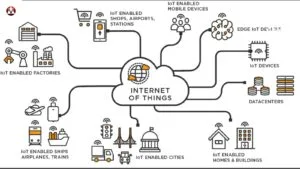
The Internet of Things (IoT) is a network of smart devices / smart objects that connect to the internet and communicate with each other. These devices can collect, send, and receive data automatically. In daily life, it powers smart homes / smart cities, wearable gadgets, and even factory machines. This connectivity allows businesses and individuals to improve productivity and make data-driven decisions.
In the United States, the Internet of Things (IoT) is transforming industries. For instance, cities use smart devices to monitor traffic, reduce energy use, and improve public safety. In homes, devices adjust lighting and temperature for comfort. Healthcare IoT (remote patient monitoring, medical equipment tracking) also allows doctors to track patients remotely, improving patient outcomes. Overall, IoT creates a connected ecosystem that is both intelligent and responsive.
|See also Orthodontic Technology: Modern Smile Innovation in the USA
How Does the Internet of Things Work?
The Internet of Things (IoT) works through sensors and actuators, connectivity, data processing, and user interfaces. Sensors collect information about the environment or user behavior. Actuators perform actions based on this data. Connectivity technologies (Wi-Fi, Bluetooth, Zigbee, LoRaWAN) transmit the data to cloud servers or nearby devices, ensuring smooth communication.
Data is analyzed using cloud computing, big data analytics, and edge computing. Cloud platforms store large amounts of data, while edge computing allows fast local processing. Users interact with IoT systems through dashboards, apps, or voice commands. For example, in manufacturing, Manufacturing IoT (machine performance, production optimization) monitors equipment, predicts failures, and triggers alerts. These mechanisms make IoT systems intelligent, efficient, and practical.
Key Components of IoT Systems
The backbone of the Internet of Things (IoT) includes IoT devices, gateways, cloud platforms, and data management strategy. Devices gather data through sensors and perform actions via actuators. Gateways connect local networks to cloud infrastructure. Cloud computing provides scalable storage and analytics, while big data analytics turns raw data into actionable insights.
Another key element is Artificial intelligence (AI) and machine learning. AI helps predict outcomes and optimize processes. For example, predictive models in Industrial IoT (IIoT) monitor machinery for predictive maintenance, reducing downtime and improving energy efficiency / sustainability. Businesses also rely on real-time analytics to optimize operations, making IoT systems smarter every day.
Types of IoT
There are several types of IoT, each serving a unique purpose. Consumer IoT focuses on smart homes / smart devices, wearables like smartwatches, RFID clothing, and lifestyle apps. It simplifies daily life, increases comfort, and improves convenience.
Industrial IoT (IIoT) powers manufacturing and production. Machines monitor themselves, optimize performance, and enhance safety. Commercial IoT serves retail and business operations, tracking customer behavior and inventory. Finally, Infrastructure IoT helps manage cities with sensors that track traffic, energy usage, and public utilities, promoting sustainability.
IoT Devices with Real-World Examples
Smart home devices include thermostats, lighting, and security cameras that adjust automatically. These systems save energy and enhance comfort. Wearables like fitness trackers and smartwatches monitor health and sync data for data-driven decision-making.
Smart cities use IoT for traffic management, pollution control, and public safety. Healthcare IoT (remote patient monitoring, medical equipment tracking) allows hospitals to monitor vitals remotely, reducing hospital stays. Factories implement Industrial IoT (IIoT) to monitor machinery, while Retail IoT (customer behavior tracking, inventory management) ensures shelves stay stocked. Agriculture IoT (soil monitoring, livestock health, smart irrigation) improves crop yield, and Transportation IoT (vehicle performance, route optimization, cargo tracking) streamlines logistics.
Applications of IoT in Different Industries
In Healthcare, IoT devices monitor patients remotely, track medical equipment, and provide real-time health insights. Hospitals use smart beds and connected diagnostic tools to improve treatment speed and accuracy.
Agriculture IoT monitors soil moisture, livestock health, and weather conditions. Farmers optimize irrigation and fertilizer use. Manufacturing IoT tracks machine performance, schedules maintenance, and reduces downtime. Retail IoT observes customer behavior, predicts trends, and improves stock management. Transportation IoT enhances vehicle tracking, route optimization, and cargo monitoring for logistics companies.
Advantages and Benefits of IoT
The Internet of Things (IoT) offers multiple benefits & business impact. Automation of processes and real-time analytics increases improved efficiency. Businesses reduce waste, cut costs, and respond faster to issues.
Cost savings and energy efficiency / sustainability are significant. Smart systems minimize downtime in factories and optimize utility consumption. Enhanced customer experience is achieved through personalization and rapid service delivery. IoT also supports data management strategy, providing actionable insights for strategy and long-term planning.
Risks and Challenges in IoT
Despite advantages, IoT faces risks & challenges. Security and privacy risks are major concerns. Devices store sensitive data, making cybersecurity / IoT security essential. Data overload from millions of devices complicates analysis.
Interoperability issues arise as different devices use varied standards. Deployment can be costly and complex. Businesses also face legal and regulatory challenges, needing compliance with regional laws. For example, U.S. companies must align with regulations like CCPA for regulatory compliance.
How Businesses Should Implement IoT
Successful IoT adoption begins with strategy planning. Companies define objectives, key metrics, and ROI expectations. Infrastructure setup requires robust networks, cloud platforms, and secure gateways.
A strong security framework is crucial for protecting sensitive data. Businesses should continuously monitor performance and adapt based on real-time analytics. Evaluation ensures long-term ROI and supports data-driven decision-making for better operational outcomes.
The Future of IoT Technology
The future trends of IoT include rapid growth of IoT devices and wider edge computing adoption. AI-driven insights enable smarter decisions in real time. Blockchain for IoT security enhances trust and transparency in device networks.
Sustainable solutions are gaining importance, combining energy efficiency / sustainability with automation. Smart cities, connected healthcare, and AI-driven IoT insights will dominate the next decade. Businesses and consumers will increasingly rely on predictive maintenance, supply chain optimization, and fully integrated smart devices.
FAQs
1. What is meant by Internet of Things (IoT)?
The Internet of Things (IoT) is a network of smart devices / smart objects that connect to the internet to collect, share, and act on data automatically.
2. What are the 4 types of IoT?
The four main types are Consumer IoT, Industrial IoT (IIoT), Commercial IoT, and Infrastructure IoT.
3. What are 5 IoT devices examples?
Smart thermostats, fitness wearables, smart refrigerators, connected cars, and industrial sensors.
4. Where is IoT mostly used?
IoT is widely used in smart homes / smart cities, Healthcare IoT, Manufacturing IoT, Retail IoT, and Transportation IoT.
5. What are the 4 main components of IoT?
IoT devices, gateways, cloud platforms, and data analytics.
6. Is Siri an example of IoT?
Yes, Siri is a voice-enabled IoT assistant that interacts with smart devices.
7. Is Alexa an IoT device?
Yes, Alexa is a smart home IoT device controlling lights, thermostats, and more.
8. Are phones an IoT device?
Smartphones can act as IoT controllers but are not strictly IoT devices themselves.
9. What are the 4 pillars of IoT?
Connectivity, sensors and actuators, data processing (cloud/edge computing), and user interface
Final Thoughts
The Internet of Things (IoT) is more than a technological trend; it is a fundamental shift in how devices, people, and businesses interact. From smart homes / smart cities to Healthcare IoT and Industrial IoT (IIoT), IoT creates intelligence, efficiency, and convenience. While challenges like cybersecurity / IoT security and interoperability exist, strategic implementation unlocks significant benefits & business impact. As AI, edge computing, and blockchain integrate further, IoT will continue reshaping industries, making life more connected, efficient, and sustainable. Businesses embracing these trends gain a strong competitive edge.