When people search for “Q-switched laser technology”, they are often looking for an explanation of what it is, how it works, and where it’s used.
Many are confused by the term (what does “Q-switched” mean?), or by its applications (tattoo removal? skin treatments? industrial uses?).
In the ever-evolving field of aesthetic and dermatological treatments, Q-switched laser technology has emerged as a cornerstone innovation.
Known for its precision and versatility, this laser modality has revolutionized how practitioners address a wide range of skin concerns—from tattoo removal to pigmentation correction.
As demand for non-invasive cosmetic procedures continues to rise, understanding the science and applications of Q-switched lasers becomes increasingly important.
What Is Q-Switched Laser Technology?
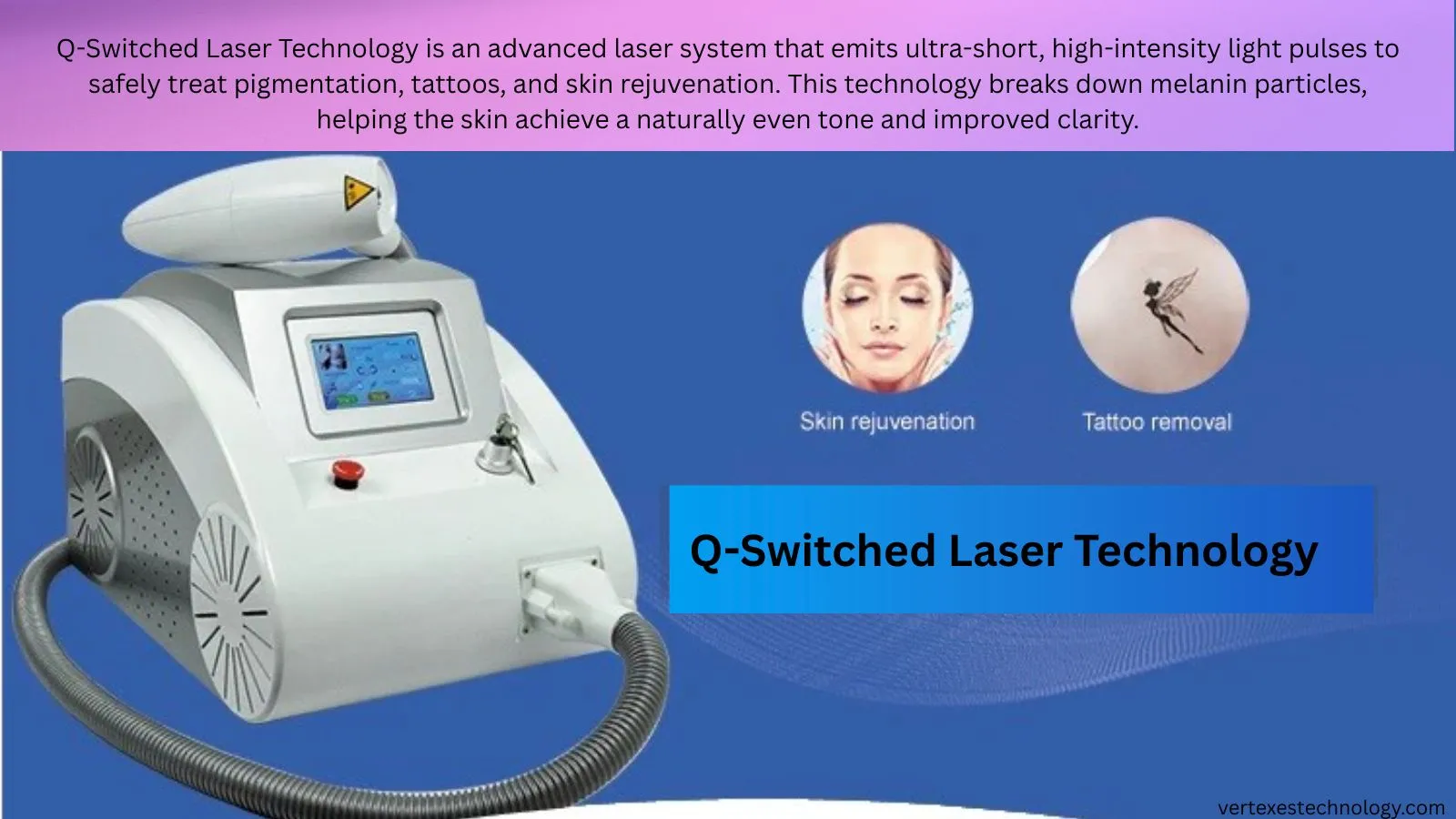
To begin with, Q-switched laser technology refers to a method of producing short, high-intensity pulses of laser energy. These pulses typically last only a few nanoseconds, yet they deliver enough power to break down pigment particles in the skin without damaging surrounding tissue. Because of this, Q-switched lasers are particularly effective for targeting melanin-rich areas and ink pigments.
The term “Q-switching” originates from the manipulation of the laser’s quality factor (Q), which controls how energy is stored and released. By delaying the emission of energy until it reaches a peak, the laser produces a sudden, intense burst. Consequently, this allows for deeper penetration and more efficient treatment outcomes.
Key Applications in Dermatology and Aesthetics
Q-switched lasers are widely used in both clinical and cosmetic settings. Most notably, they are considered the gold standard for tattoo removal. Unlike older methods, which often left scars or incomplete results, Q-switched lasers can effectively break down ink particles of various colors, especially black, blue, and green.
In addition to tattoo removal, these lasers are also used to treat:
- Pigmented lesions such as freckles, sun spots, and melasma
- Birthmarks and café-au-lait spots
- Post-inflammatory hyperpigmentation
- Skin rejuvenation through collagen stimulation
Moreover, some practitioners use Q-switched lasers for non-ablative skin resurfacing, which improves skin tone and texture without significant downtime.
Advantages Over Other Laser Technologies
Compared to continuous-wave lasers or even some newer systems, Q-switched lasers offer several distinct benefits:
- Precision targeting of pigment with minimal thermal damage
- Shorter recovery time due to non-invasive nature
- Versatility across different skin types and conditions
- Reduced risk of scarring or post-treatment complications
Furthermore, because the pulses are so brief, the surrounding skin remains largely unaffected. This makes the treatment safer and more comfortable for patients, especially those with sensitive skin.
Transitioning to Smarter, More Adaptive Systems
As technology continues to advance, Q-switched lasers are being integrated with smart sensors and AI-driven platforms. These enhancements allow for real-time adjustments based on skin response, thereby improving both safety and efficacy. Additionally, some systems now offer multi-wavelength capabilities, enabling practitioners to treat a broader range of pigment colors in fewer sessions.
Although picosecond lasers have entered the market with even shorter pulse durations, Q-switched systems remain a reliable and cost-effective option for many clinics. In fact, they are often preferred for their proven track record and wide range of clinical applications.
Safety Considerations and Best Practices
Despite their effectiveness, Q-switched lasers must be used with care. Proper training and certification are essential to ensure safe outcomes. Moreover, patient education plays a crucial role. Individuals should be informed about the number of sessions required, potential side effects, and post-treatment care.
When administered correctly, side effects are generally mild and temporary. These may include redness, swelling, or slight discomfort, all of which typically subside within a few days.
The Future of Q-Switched Laser Technology
Looking ahead, the future of Q-switched laser technology appears promising. Researchers are exploring ways to enhance pulse modulation, improve energy delivery, and integrate more advanced cooling systems. As a result, treatments are expected to become even more efficient and comfortable.
Additionally, the combination of Q-switched lasers with other modalities—such as fractional lasers or radio frequency devices—may open new avenues for comprehensive skin therapy. This multi-modal approach could further improve outcomes for complex skin conditions.
Q-Switched Laser Technology – Quick Answer
“Q-switched laser technology” refers to a type of laser system that uses a special technique (called “Q-switching”) to release stored energy in very short, high-power pulses. In practice: a laser beam is held back (via a “Q-switch”), energy builds up in the lasing medium, then the switch lets it out all at once — resulting in a very short pulse of very high peak power.
Examples:
- Removing a tattoo: the laser pulses break the ink into small fragments which the body clears.
- Pigmentation treatment: short pulses target melanin or other pigment without destroying surrounding skin.
- Material processing: fine engraving or marking of metal, ceramics or polymers, where you need precision but minimal heat effect.
Thus, Q-switched laser technology is powerful, precise, and used both in medical/cosmetic settings and in industrial/engineering environments.
The Origin of Q-Switched Laser Technology
The quality factor of the laser’s optical resonator, or cavity, is denoted by the letter “Q,” hence the phrase “Q-switched” in laser physics. A low quality factor (Q) results in substantial laser losses and prevents lasing from building up; a high Q causes the stored energy to be released in a single burst.
Gordon Gould originally proposed the Q-switching approach in 1958, and R. W. Hellwarth and F. J. McClung separately demonstrated it in 1961–1962.
This idea was eventually extended to a variety of laser media and eventually made its way into industrial lasers and cosmetic dermatology (for the removal of pigmentation and tattoos).
Although you could see “Q-switch” (noun) or “Q-switched” (adjective) in technical books, the spelling “Q-switched laser” just comes from the technique; there is no other “Q-switch” vs. “Q switched” main variety.
British English vs American English Spelling
In terms of “Q-switched laser technology”, there is no significant spelling difference between British and American English—the term is technical and stays the same in both. However, for completeness and in the context of other words, here is a comparison of some common spelling differences:
| UK Spelling | US Spelling | Notes/Examples |
|---|---|---|
| colour | color | “-our” vs “-or” ending. |
| centre | center | “-re” vs “-er”. |
| organise / realise | organize / realize | “-ise” vs “-ize” |
| defence | defense | “-ce” vs “-se” |
| travelling | traveling | Doubling of L in UK. |
Since “Q-switched laser technology” doesn’t involve any of these variant suffixes or endings, you can use the same spelling globally.
Which Spelling Should You Use?
Given the technical nature of “Q-switched laser technology”, you should use the term exactly as is — with hyphen after “Q”, the past-participle “switched”, and “laser technology”. Because there’s no variant spelling, the main issue is choosing whether to adopt UK or US style overall for your writing.
- If your audience is primarily in the United States, you can write in American English (e.g., “color”, “center”, etc.).
- If your audience is primarily in the UK or Commonwealth countries, you might choose British English (e.g., “colour”, “centre”).
- If your audience is international (global web traffic), you should simply be consistent in your spelling. Since “Q-switched laser technology” is unaffected by typical UK/US spelling differences, you just need to ensure the remainder of your document aligns with either UK or US style.
In short: the key is consistency, not switching mid-document.
Common Mistakes with Q-Switched Laser Technology
Here are frequent errors and how to correct them:
- Mistake: “Q switch laser” (without hyphen).
Correction: “Q-switched laser” (hyphen and past participle) or “Q switch laser” (if noun form) depending on context. - Mistake: “Q-Switched Lasar Technology” (typo in “laser”).
Correction: “laser”. - Mistake: Omitting “technology” or “system” when context requires precision (“Q-switched laser” vs “Q-switched laser technology”).
Correction: Use full phrase if you mean the technology broadly, or “Q-switched laser” if you refer to the device. - Mistake: Confusing “Q-switched” with “mode-locked” or other laser pulse techniques.
Correction: Understand that “Q-switched” means very short, high-power pulses from energy storage in the cavity; it is distinct from “mode-locking” (which produces much shorter femtosecond pulses often). - Mistake: Saying “Q-switched laser technologies” (plural incorrectly) when referring to the general technique.
Correction: You can say “Q-switched laser technologies” if you mean various implementations, but check the surrounding context for clarity.
By avoiding these mistakes you’ll convey professionalism and technical accuracy.
Q-Switched Laser Technology in Everyday Examples
Here are sentences showing usage in different types of writing:
- Email (informal):
“Hi Sam, I’m looking at a clinic that uses Q-switched laser technology for pigment removal — could you check if it’s safe for my skin type?” - News headline / social media:
“New study shows Q-switched laser technology dramatically improves tattoo removal success rates.” - Formal writing / report:
“The clinic uses Q-switched laser technology, particularly pulses at wavelengths of 1064 nm and 532 nm, to target both dark inks and coloured pigments with minimal downtime.” - Blog post / website copy:
“Understanding how Q-switched laser technology works can help you decide whether it’s suitable for your skin concerns.”
In each case the term is used properly, hyphenated and capitalised as appropriate, and integrated into the context for clarity.
Q-Switched Laser Technology – Google Trends & Usage Data
While exact Google Trends data for “Q-switched laser technology” may be limited, we can discuss general usage and popularity by context:
- The term appears in dermatology and cosmetic treatment websites, showing interest in skin-pigmentation and tattoo-removal markets.
- It also appears in industrial laser and material-processing contexts, which suggests a dual-market presence.
- Geographically, regions with strong cosmetic-dermatology demand (e.g., US, UK, Australia, East-Asia) will show higher search frequency.
Given this, if you optimise content around this keyword, you’ll likely appeal to both consumer (cosmetic) and technical (industrial) audiences.
Tip: Use modifiers like “for tattoo removal”, “in dermatology”, “industrial material processing” to capture variations of user intent.
Comparison Table (Keyword Variations)
| Variation | Use case / nuance |
|---|---|
| Q-switched laser technology | Broad term for the technique + system. |
| Q-switched laser | Device / laser itself (less emphasis on “technology”). |
| Q-switch laser technology | Slight variation (less common) |
| Q-switched lasers | Plural form when discussing multiple systems |
| Q-switched laser treatment | Use when focusing on the application (clinical/cosmetic). |
FAQs
Q1. What does “Q-switched” mean in laser technology?
A: It refers to a technique wherein the quality (Q) of the laser cavity is held low to store energy, then rapidly switched high to release that energy as a short, high-power pulse.
Q2. Is Q-switched laser technology safe for all skin types?
A: It is generally considered safe when performed by a qualified professional, but effectiveness and risk vary with skin type, pigment colour, and the laser wavelength used.
Q3. What kinds of applications use Q-switched lasers?
A: Applications include tattoo removal, pigment lesions (age spots, melasma), skin rejuvenation, and industrial uses like engraving, marking, laser cutting or drilling.
Q4. How many sessions of treatment are needed when using this technology for cosmetic purposes?
A: It depends on the condition; for example tattoo removal may need multiple sessions (6-20) spaced over months.
Q5. What wavelengths are common in Q-switched laser systems?
A: Popular wavelengths include 1064 nm (for dark inks/pigments) and 532 nm (for red/green inks/pigments) in dermatological use.
Q6. Is “Q-switched laser technology” the same as “picosecond laser technology”?
A: No — both are short-pulse lasers, but picosecond lasers have even shorter pulses (picoseconds vs nanoseconds) and may be more effective in certain pigment or tattoo treatments.
Q7. Can Q-switched laser technology be used for industrial material processing?
A: Yes — due to the high peak power and short pulses, it is used for fine material processing, micromachining, engraving, and marking.
Conclusion
In summary, Q-switched laser technology remains a vital tool in the arsenal of modern dermatology and aesthetic medicine. Its ability to deliver high-intensity energy with pinpoint accuracy makes it ideal for treating a variety of pigment-related concerns. While newer technologies continue to emerge, the Q-switched laser’s reliability, safety, and versatility ensure its continued relevance in clinical practice.