
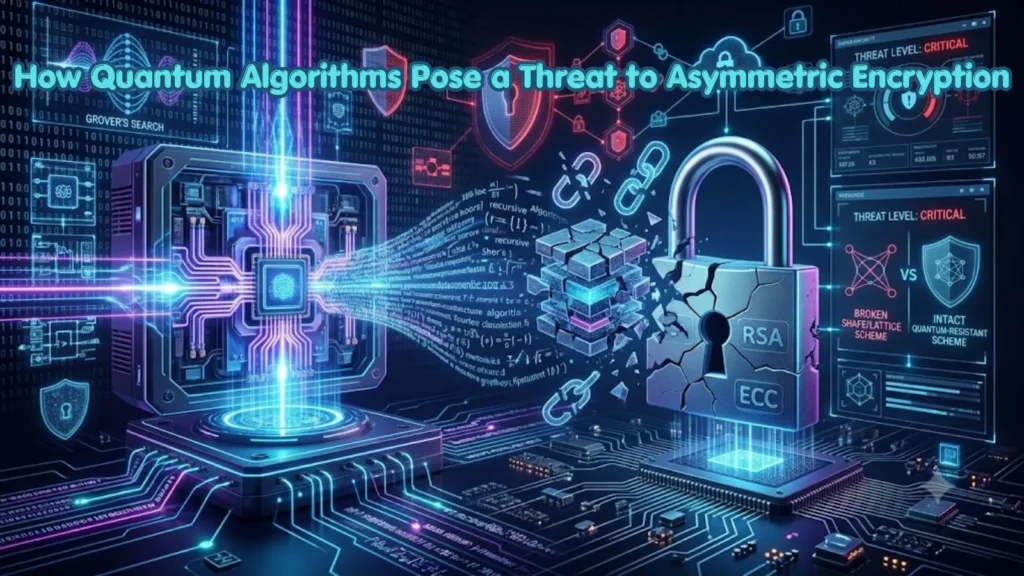
Modern cybersecurity depends on encryption to protect online banking, healthcare records, government systems, and personal communication. However, the rapid progress of quantum computing has introduced new challenges that traditional security methods were never designed to handle. Unlike classical computers, a powerful quantum computer can solve certain mathematical problems much faster, making today’s asymmetric encryption vulnerable in the future.
Understanding How Quantum Algorithms Pose a Threat to Asymmetric Encryption helps individuals, businesses, and government agencies prepare for the next generation of cybersecurity. While large-scale quantum attacks are not possible today, experts already encourage organizations to adopt post-quantum cryptography and strengthen cryptographic security before quantum technology reaches its full potential.
Related: HomerocketRealty Modern Technology
Quick Answer
How Quantum Algorithms Pose a Threat to Asymmetric Encryption can be explained in one sentence: powerful quantum algorithms, especially Shor’s algorithm, could solve the mathematical problems that protect today’s RSA encryption and ECC encryption. Meanwhile, Grover’s algorithm weakens some forms of symmetric encryption, although stronger key sizes remain effective. Because of this growing risk, security experts are developing quantum-safe cryptography and quantum-resistant encryption to protect future digital communications.
However, today’s quantum machines remain limited by hardware, stability, and error correction. Organizations still have time to prepare, yet planning should begin now because sensitive information stolen today could be decrypted years later. This strategy, known as harvest now decrypt later, has become one of the biggest concerns in modern cybersecurity.
What Is Asymmetric Encryption?
Traditional online security relies heavily on asymmetric encryption, also known as public key cryptography. This system uses two separate encryption keys. One key remains public and anyone can use it to encrypt information. The second key stays private and only the intended recipient can unlock the message. This approach protects websites, online shopping, software updates, digital wallets, and secure business communications without sharing secret passwords in advance.
Unlike older security systems, private key cryptography uses only one shared key for both encryption and decryption. Although that method works well for speed, distributing the secret key safely creates challenges. Public key infrastructure (PKI) solves this problem by managing certificates and verifying identities across the internet. As a result, digital signatures, key exchange, Authentication, Digital Identity, Secure Email, Secure Messaging, VPN Encryption, and Data Encryption all depend on reliable asymmetric cryptography.
Public Key vs Private Key
| Feature | Public Key | Private Key |
|---|---|---|
| Visibility | Shared openly | Kept secret |
| Purpose | Encrypt data and verify signatures | Decrypt data and create signatures |
| Used In | RSA algorithm, elliptic curve cryptography | Secure communication |
| Security | Safe to distribute | Must never be exposed |
How RSA Works
The RSA algorithm protects information by relying on integer factorization, a mathematical problem that classical computers find extremely difficult. Creating an RSA key involves multiplying two enormous prime numbers. While multiplication happens quickly, reversing the process becomes incredibly demanding for traditional computers. This complexity has made RSA encryption one of the most trusted encryption algorithms for decades.
How ECC Works
Elliptic curve cryptography offers similar protection while using much smaller keys. Instead of prime factorization, ECC encryption depends on the discrete logarithm problem, another calculation that remains extremely difficult for classical computers. Because it provides strong security with better efficiency, ECC protects smartphones, cloud services, financial applications, and connected devices across the modern internet.
Why Asymmetric Encryption Is Important
Every time someone signs into an online bank, purchases products, downloads trusted software, or visits an HTTPS website, asymmetric encryption quietly protects sensitive information. It forms the backbone of secure communication, secure internet connections, Cloud Security, Banking Security, Government Cybersecurity, Healthcare Data Protection, Enterprise Security, and Information Security. Without reliable public-key systems, modern digital commerce and online privacy would struggle to exist safely.
What Is Quantum Computing?
Unlike traditional computers that process information as bits containing either 0 or 1, quantum computing uses qubits capable of representing multiple states simultaneously. This remarkable capability allows a quantum computer to explore many possible solutions at once instead of checking one answer after another. Consequently, certain calculations that would take thousands of years on classical machines may eventually require only hours or minutes.
Furthermore, quantum systems rely on scientific principles called superposition and entanglement. These properties create extraordinary computational power for specific mathematical tasks rather than every type of calculation. Although today’s machines remain experimental, researchers believe future quantum devices could transform medicine, logistics, artificial intelligence, material science, and quantum cybersecurity while also creating new encryption vulnerabilities.
Classical Computers vs Quantum Computers
| Classical Computer | Quantum Computer |
|---|---|
| Uses bits | Uses qubits |
| Solves problems sequentially | Explores many possibilities simultaneously |
| Best for everyday computing | Best for complex mathematical problems |
| Limited by binary processing | Uses quantum mechanics |
Qubits Explained
A qubit behaves differently from a traditional computer bit because it can exist in several possible states before measurement. This flexibility dramatically increases computing efficiency for specialized problems. However, qubits remain fragile and require extremely stable environments to operate correctly.
Superposition and Entanglement
Superposition allows qubits to represent multiple possibilities simultaneously, while entanglement creates powerful relationships between qubits even across physical distance. Together, these principles give quantum algorithms their extraordinary computational advantage. As research advances toward quantum supremacy, experts continue evaluating how this progress will reshape future of encryption, cryptographic standards, NIST PQC, quantum-resistant algorithms, migration to post-quantum cryptography, and long-term secure data protection.
Why Today’s Quantum Computers Cannot Break RSA Yet
Although headlines often suggest that quantum computers will soon break modern encryption, the reality is far more balanced. Today’s quantum computer technology remains in its early stages. Researchers have built impressive machines, yet they still contain limited qubits and experience frequent errors during calculations. As a result, no existing system can successfully run Shor’s algorithm on the large encryption keys used in real-world RSA encryption. This means online banking, secure websites, and business networks remain protected for now.
However, waiting until quantum computers become powerful is not a wise strategy. Upgrading global security infrastructure takes many years. Millions of websites, financial institutions, healthcare providers, and government agencies depend on public key cryptography every day. Consequently, organizations are beginning the migration to post-quantum cryptography now to avoid rushed upgrades later and maintain long-term Information Security and secure data protection.
Current Hardware Limitations
Modern quantum processors contain hundreds or, in some cases, a few thousand physical qubits. Breaking commonly used RSA keys would require millions of reliable, error-corrected qubits working together for long periods. Current hardware cannot maintain that level of stability because qubits are extremely sensitive to heat, vibration, and electromagnetic interference. Therefore, today’s quantum machines remain valuable research tools rather than practical code-breaking devices.
Error Correction Challenges
One of the biggest obstacles in quantum computing is error correction. Unlike classical bits, qubits lose their quantum state very easily through a process called decoherence. Scientists must constantly detect and correct these errors before meaningful calculations can finish. This requirement dramatically increases the number of physical qubits needed to create one reliable logical qubit, slowing progress toward large-scale quantum security applications.
Required Qubits and Timeline
Security researchers estimate that breaking 2048-bit RSA keys would require millions of stable, fault-tolerant qubits. Current systems remain far below that threshold. While experts disagree on the exact timeline, many believe practical quantum attacks are still years away. Nevertheless, sensitive information protected today may need to remain confidential for decades, making early preparation a sensible cybersecurity strategy.
Post-Quantum Cryptography
Instead of waiting for quantum computers to mature, researchers have created post-quantum cryptography to protect digital information against both classical and future quantum attacks. Unlike RSA and ECC, these new quantum-resistant algorithms rely on mathematical problems that neither classical nor quantum computers can efficiently solve with current knowledge. Their goal is simple: preserve trust in online communication even after powerful quantum machines become available.
This proactive approach allows businesses to modernize security without abandoning existing infrastructure overnight. Many organizations now test hybrid systems that combine traditional encryption with quantum-safe cryptography. Consequently, the transition becomes smoother while reducing future risk. This strategy strengthens Cloud Security, Enterprise Security, Authentication, Digital Identity, and long-term Data Privacy across public and private sectors.
What Is Post-Quantum Cryptography?
Post-quantum cryptography refers to encryption methods specifically designed to resist attacks from future quantum computers. These systems work on today’s computers while remaining compatible with existing networks, making them practical for gradual deployment. Unlike quantum cryptography, which requires specialized hardware, post-quantum solutions mainly involve software updates.
NIST Standards
The U.S. National Institute of Standards and Technology has led the global effort to standardize quantum-resistant encryption. Through the NIST PQC project, researchers evaluated dozens of candidates before selecting several algorithms for future adoption. These standards provide organizations with trusted guidance for protecting sensitive information well before quantum attacks become practical.
Quantum-Resistant Algorithms
Several promising technologies support the future of secure encryption. Lattice-based cryptography currently leads adoption because of its strong balance between performance and security. Hash-based cryptography, code-based cryptography, and multivariate cryptography also provide specialized solutions for different cybersecurity needs. Together, these innovations form the foundation of future cryptographic standards and quantum-resistant encryption.
Migration Strategies
Successful migration begins with identifying where vulnerable encryption exists. Organizations should inventory their systems, update software regularly, replace outdated certificates, and adopt crypto-agile architectures that allow future algorithm changes without rebuilding entire networks. Early planning reduces cost while improving resilience against evolving cyber threats.
Future of Cybersecurity in the Quantum Era
The arrival of practical quantum computers will reshape the cybersecurity landscape rather than destroy it. History shows that encryption has continuously evolved whenever new threats emerged. Just as stronger internet security replaced outdated protocols over time, cryptographic transition toward quantum-resistant systems will become another milestone in digital innovation. Businesses that prepare early will adapt more smoothly than those waiting until regulations require immediate action.
Looking ahead, governments, universities, and technology companies continue investing billions in quantum research. At the same time, cybersecurity professionals develop stronger defenses, better standards, and more flexible encryption systems. This balanced progress ensures that the future of encryption remains secure even as computing power advances. While quantum supremacy may transform scientific discovery, ongoing investment in cybersecurity, secure communication, and cryptographic security will help protect digital life for generations.
Government Initiatives
The United States and many allied nations have launched national quantum strategies to accelerate research while strengthening cybersecurity. Federal agencies encourage organizations to evaluate current encryption, follow NIST PQC guidance, and prepare for future compliance requirements.
Industry Adoption
Technology companies, financial institutions, healthcare providers, and cloud service providers are already testing quantum-safe cryptography solutions. Many vendors now offer hybrid encryption products that combine existing algorithms with post-quantum alternatives, allowing gradual adoption without disrupting daily operations.
Preparing for Quantum-Safe Security
Preparation begins with awareness, planning, and regular security assessments. Organizations should monitor evolving standards, educate security teams, update software, and choose vendors committed to quantum-resistant algorithms. These practical steps reduce long-term risk while supporting reliable secure communication, Data Encryption, and Zero Trust Security across modern digital environments.
Frequently Asked Questions
Can quantum computers break RSA?
Not yet. Current quantum machines are far too small and unstable to break modern RSA encryption. However, researchers believe future fault-tolerant quantum computers could eventually run Shor’s algorithm efficiently. That is why organizations are preparing for post-quantum cryptography instead of waiting until the threat becomes immediate.
Can quantum computers break AES?
A future quantum computer could use Grover’s algorithm to reduce the effective security of AES encryption, but it would not completely break it. Therefore, AES-256 remains one of the strongest choices for protecting sensitive information and is widely recommended for long-term Data Encryption.
What is Shor’s Algorithm?
Shor’s algorithm is a quantum algorithm developed by Peter Shor in 1994. It solves integer factorization and the discrete logarithm problem much faster than classical computers. As a result, it poses a serious future threat to public key cryptography, including RSA and ECC.
What is Grover’s Algorithm?
Grover’s algorithm is a quantum search algorithm that speeds up finding encryption keys. Unlike Shor’s Algorithm, it does not completely break symmetric encryption. Instead, it reduces the time needed to search possible keys, making larger key sizes the best defense.
What is Post-Quantum Cryptography?
Post-quantum cryptography refers to new quantum-resistant algorithms designed to remain secure against both classical and quantum computers. Many of these algorithms are based on lattice-based cryptography, hash-based cryptography, and code-based cryptography, and they are being standardized through NIST PQC.
When Will Quantum Computers Become Dangerous?
Experts cannot predict an exact date because progress depends on advances in hardware and error correction. Most researchers agree that organizations should begin preparing now because upgrading global encryption systems may take many years.
Key Takeaways
| Topic | Key Insight |
|---|---|
| Quantum Computing | Offers revolutionary computing power for complex mathematical problems. |
| Asymmetric Encryption | RSA and ECC face future risks from Shor’s algorithm. |
| Symmetric Encryption | AES remains strong, especially with larger key sizes. |
| Post-Quantum Cryptography | Provides the best long-term defense against quantum attacks. |
| NIST PQC | Leading global effort to standardize quantum-resistant encryption. |
| Future Outlook | Early planning ensures stronger cryptographic security and secure communication. |
Final Thoughts
How Quantum Algorithms Pose a Threat to Asymmetric Encryption is no longer just a theoretical discussion. It has become an important topic for governments, businesses, and cybersecurity professionals worldwide. Although today’s quantum computers cannot break modern encryption, rapid technological progress makes preparation essential. Fortunately, post-quantum cryptography, stronger quantum-resistant encryption, and updated cryptographic standards offer practical solutions for the future. Organizations that begin planning today will protect sensitive information more effectively and stay ahead of tomorrow’s cybersecurity challenges. As quantum technology evolves, proactive security strategies will remain the strongest defense against emerging digital threats.