
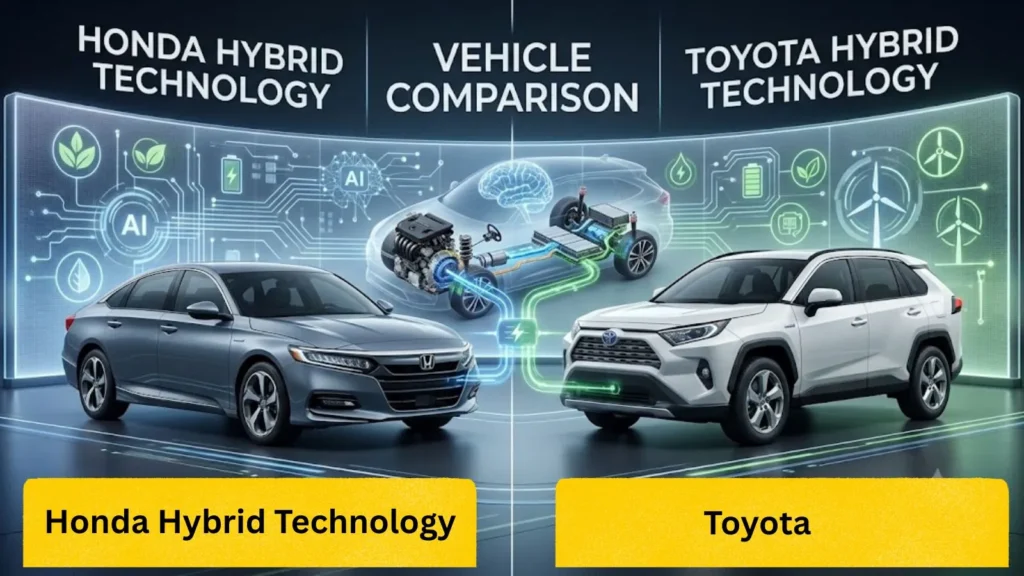
Which is better, Honda hybrid technology vs Toyota?
Toyota generally leads in fuel economy and long-term reliability, while Honda often delivers a more engaging driving experience.
Buying a hybrid car sounds easy until you compare Honda hybrid technology vs Toyota. Both companies have spent decades improving their hybrid systems. Both promise lower fuel costs, cleaner driving, and dependable performance. Yet their technology works in different ways.
Many drivers assume every hybrid vehicle works the same. That is not true. Honda and Toyota use different engineering approaches to combine gasoline engines with electric motors. Those design choices affect acceleration, fuel economy, maintenance costs, and even the driving experience.
You’ll discover how each system works, where each brand performs best, and which one offers better value for different types of drivers. Whether you’re planning to buy your first hybrid or upgrade your current vehicle, this comparison will help you make a smarter decision.
RELATED: Technologia Meme Explained– The Viral Internet Trend
What is Honda Hybrid Technology vs Toyota?
Honda hybrid technology vs Toyota is a comparison between the hybrid powertrain systems developed by two of Japan’s largest automakers.
A hybrid vehicle combines a gasoline engine with one or more electric motors. The goal is to improve fuel efficiency while reducing emissions.
Honda mainly uses its e:HEV Hybrid System, also called the Intelligent Multi-Mode Drive (i-MMD). Toyota relies on its famous Hybrid Synergy Drive (HSD), which has been refined since the launch of the first Prius.
Both systems deliver excellent fuel economy, but they achieve it using different engineering methods.
| Feature | Honda Hybrid | Toyota Hybrid |
|---|---|---|
| Main System | e:HEV (i-MMD) | Hybrid Synergy Drive |
| Electric Driving | More frequent | Balanced use |
| Fuel Economy | Excellent | Industry-leading |
| Driving Feel | Sportier | Smoother |
| Reliability | Very High | Exceptional |
How Does Honda Hybrid Technology vs Toyota Work?
Although both systems combine gasoline and electric power, their operation differs.
Honda e:HEV System
Honda’s system lets the electric motor perform most of the driving.
At lower speeds:
- The battery powers the electric motor.
- The gasoline engine often acts as a generator.
- Direct engine power is used mainly during highway driving.
This makes Honda hybrids feel more like electric vehicles during city driving.
Toyota Hybrid Synergy Drive
Toyota blends engine power and electric power continuously.
Its electronic continuously variable transmission (eCVT) automatically chooses the most efficient combination of:
- Gasoline engine
- Electric motor
- Battery pack
Drivers never need to switch modes manually.
The computer constantly balances power for maximum efficiency.
Key Features of Honda Hybrid Technology vs Toyota
Both manufacturers include advanced technology, but their priorities differ.
Honda Highlights
- Bold e:HEV hybrid system
- Strong electric motor
- Smooth acceleration
- Quick throttle response
- Quiet cabin at city speeds
- Regenerative braking
- Smart energy management
Toyota Highlights
- Hybrid Synergy Drive
- Proven eCVT transmission
- Excellent fuel economy
- Long battery lifespan
- Predictable driving experience
- Advanced battery cooling
- Reliable regenerative braking
Shared Features
Both brands include:
- Lithium-ion battery or Nickel-metal hydride battery
- Automatic energy recovery
- Engine auto stop/start
- Low emissions
- Smart charging system
- Digital energy monitoring
- Electric motor assistance
Benefits of Honda Hybrid Technology vs Toyota
Choosing either system offers several advantages.
Lower Fuel Costs
Hybrid vehicles consume less gasoline than traditional cars.
Many owners save hundreds of dollars every year.
Reduced Carbon Emissions
The electric motor reduces fuel consumption.
Less fuel burned means fewer greenhouse gas emissions.
Better City Driving
Stop-and-go traffic becomes more efficient.
Electric motors provide smooth starts without wasting fuel.
Quiet Operation
Electric mode produces almost no engine noise.
Cabins remain peaceful during low-speed driving.
Lower Brake Wear
Regenerative braking helps recharge the battery while reducing brake pad wear.
Excellent Resale Value
Hybrid models from Honda and Toyota often retain strong resale prices because of their reputation for reliability.
Real-World Applications of Honda Hybrid Technology vs Toyota
Hybrid technology works well for many driving situations.
Daily Commuting
City commuters benefit the most because electric motors handle frequent stops.
Family Vehicles
Hybrid SUVs like the Honda CR-V Hybrid and Toyota RAV4 Hybrid provide efficiency without sacrificing cargo space.
Long Highway Trips
Both systems perform well on highways.
Toyota usually delivers slightly better overall fuel economy during long-distance travel.
Honda often feels more responsive while overtaking slower vehicles.
Ride-Sharing
Taxi and ride-share drivers frequently choose Toyota hybrids because of their outstanding long-term reliability.
Honda hybrids are becoming increasingly popular in this market as well.
Advantages and Disadvantages
Honda Hybrid Advantages
- More enjoyable acceleration
- Strong electric driving experience
- Smooth transitions
- Responsive steering
- Quiet operation
Honda Hybrid Disadvantages
- Slightly lower fuel economy in some models
- Smaller hybrid lineup
- Higher engine activity during steep climbs
Toyota Hybrid Advantages
- Outstanding fuel efficiency
- Extremely reliable
- Larger hybrid model range
- Excellent resale value
- Lower long-term ownership costs
Toyota Hybrid Disadvantages
- eCVT can feel less sporty
- Engine sound may increase during hard acceleration
- Less engaging driving dynamics
Is Honda Hybrid Technology vs Toyota Safe and Secure?
Yes.
Both companies build hybrid systems with extensive safety measures.
Their batteries are protected by:
- Temperature monitoring
- High-voltage insulation
- Automatic shutdown systems
- Crash detection technology
- Battery management software
Both manufacturers also include advanced driver assistance features in many hybrid models.
Examples include:
- Adaptive Cruise Control
- Lane Keeping Assist
- Automatic Emergency Braking
- Blind Spot Monitoring
- Collision Mitigation Systems
Battery fires remain extremely rare because hybrid batteries include multiple protective layers and electronic safeguards.
Honda Hybrid Technology vs Toyota vs Conventional Gasoline Cars
Compared with traditional gasoline vehicles, hybrids provide several advantages.
| Feature | Hybrid | Gasoline Car |
|---|---|---|
| Fuel Economy | Higher | Lower |
| Emissions | Lower | Higher |
| Maintenance | Similar | Similar |
| Engine Wear | Less | More |
| Noise | Lower | Higher |
| Fuel Savings | Significant | Limited |
Drivers covering many miles each year often recover the higher purchase price through fuel savings.
Future of Honda Hybrid Technology vs Toyota
Hybrid technology continues to improve every year.
Honda plans to expand its e:HEV lineup while preparing more fully electric vehicles.
Toyota continues investing in:
- Next-generation hybrid systems
- Improved battery technology
- Solid-state batteries
- Plug-in hybrids
- Hydrogen fuel-cell vehicles
Artificial intelligence and smarter energy management systems will likely make future hybrids even more efficient.
Battery durability should also improve as new materials become available.
Common Problems and Solutions
Battery Aging
Problem
Hybrid batteries slowly lose capacity over many years.
Solution
Regular servicing and proper cooling help maximize battery life.
Reduced Winter Efficiency
Problem
Cold temperatures reduce battery performance.
Solution
Allow the vehicle to warm naturally before demanding maximum power.
Regenerative Braking Feel
Problem
Some drivers need time to adjust.
Solution
Most owners become comfortable after a few days of driving.
Higher Purchase Price
Problem
Hybrid vehicles cost more initially.
Solution
Fuel savings usually offset the extra cost over time.
FAQs
Which hybrid lasts longer?
Both systems are highly durable. Toyota has a slightly longer history of proven hybrid reliability.
Is Honda hybrid more powerful?
Many Honda hybrids feel quicker because the electric motor provides strong instant torque.
Which hybrid saves more fuel?
Toyota hybrids usually achieve slightly better fuel economy in most driving conditions.
Are hybrid batteries expensive to replace?
Replacement costs have decreased significantly, and most batteries last well beyond 150,000 miles with proper care.
Which brand has lower maintenance costs?
Both have reasonable maintenance costs, although Toyota often has a small advantage due to its longer hybrid track record.
Should I buy Honda or Toyota hybrid?
Choose Honda if you prefer responsive performance. Choose Toyota if maximum fuel economy and proven reliability are your priorities.
Final Verdict
The debate over Honda hybrid technology vs Toyota has no single winner because each system excels in different areas.
Honda builds hybrids that feel lively and enjoyable to drive. Its e:HEV technology relies heavily on electric power, creating smooth acceleration and an almost electric-car experience around town.
Toyota remains the benchmark for fuel efficiency, reliability, and long-term ownership costs. Its Hybrid Synergy Drive has decades of real-world success and continues to set industry standards.
If you value sporty performance and responsive driving, Honda is an excellent choice. If your top priorities are maximum fuel savings, proven durability, and resale value, Toyota remains difficult to beat.
Either option represents a smart investment for drivers seeking cleaner, more efficient transportation without giving up the convenience of a gasoline engine.