
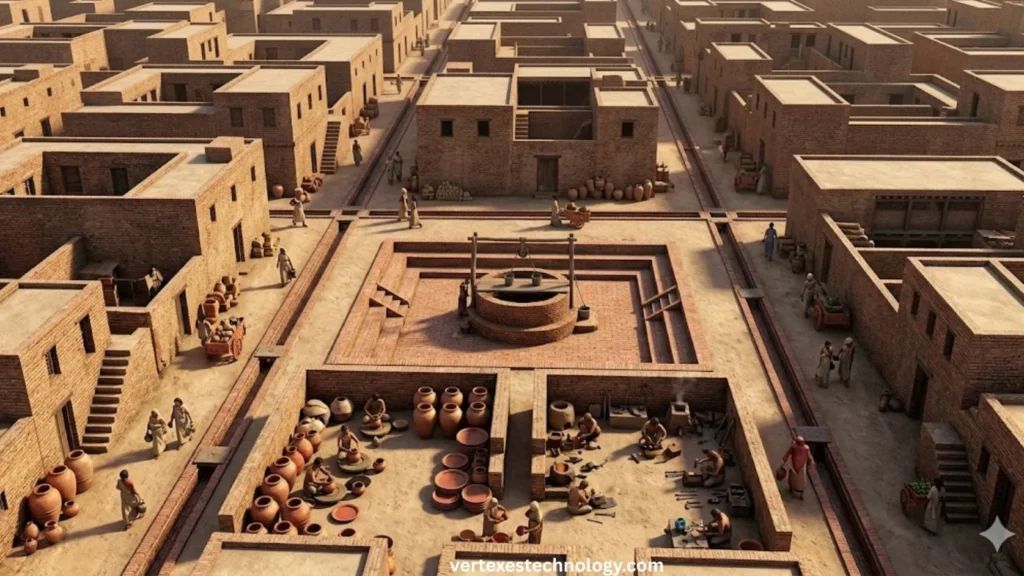
Imagine a city built over 4,000 years ago with drainage systems better than some modern towns. No computers. No AI. Yet, the planning feels almost automated. This is the mystery and brilliance of Harappan civilization technology.
Ancient engineers created structured cities, efficient water systems, and standardized tools. Their methods still inspire modern industry, innovation, and urban design.
What is Harappan Civilization Technology?
Harappan civilization technology refers to the tools, systems, and engineering practices developed by the Indus Valley Civilization (around 2600–1900 BCE).
It includes advancements in:
- Urban planning
- Water management
- Construction methods
- Craft production
- Trade systems
This ancient “technology stack” functioned like a well-integrated system. It combined hardware (tools, bricks) and early “software-like” systems (planning, measurement standards).
How Does Harappan Civilization Technology Work?
The system worked through careful planning and standardization.
Cities were built on grid layouts. Roads intersected at right angles. Houses connected to drainage networks.
Key operational principles included:
- Modular design: Uniform brick sizes ensured compatibility
- Decentralized systems: Each house had its own water access
- Automation-like efficiency: Gravity-based drainage required no active control
This resembles modern automation systems where processes run with minimal intervention.
Key Features of Harappan Civilization Technology
1. Advanced Urban Planning
Cities like Mohenjo-Daro followed strict layouts. Streets aligned in grids. Zones separated residential and industrial areas.
2. Drainage and Sanitation Systems
Covered drains ran along streets. Wastewater moved efficiently. Maintenance holes allowed cleaning.
3. Standardized Construction Materials
Bricks followed fixed ratios (1:2:4). This ensured strength and uniformity.
4. Water Management Systems
Wells were common in homes. Public baths showed complex hydraulic design.
5. Craft and Industrial Tools
Workers used advanced tools for pottery, bead-making, and metallurgy.
6. Trade and Measurement Systems
Weights and measures were standardized. This supported fair trade across regions.
Benefits of Harappan Civilization Technology
- Efficiency: Systems reduced waste and manual effort
- Scalability: Standard designs allowed easy expansion
- Sustainability: Use of local materials minimized environmental impact
- Public Health: Clean water and sanitation reduced disease risks
- Reliability: Simple systems required less maintenance
These benefits align with modern goals in software engineering and smart city development.
Real-World Applications of Harappan Civilization Technology
Even today, elements of Harappan civilization technology influence modern systems.
Urban Planning
Grid-based city designs are used worldwide.
Water Infrastructure
Modern drainage systems still follow gravity-based designs.
Construction Industry
Standardized materials improve efficiency and reduce costs.
Industrial Design
Mass production uses uniform measurements, similar to Harappan practices.
Smart City Development
Automation concepts mirror Harappan passive systems.
Advantages and Disadvantages
Advantages
- Highly organized systems
- Low maintenance infrastructure
- Strong focus on hygiene
- Scalable urban design
- Early form of system integration
Disadvantages
- Limited technological diversity
- No advanced machinery or software
- Dependence on manual labor
- Lack of written technical documentation
Is Harappan Civilization Technology Safe and Secure?
From a technical perspective, Harappan civilization technology was remarkably safe.
- Cybersecurity equivalent: Standardization reduced errors and misuse
- System reliability: Passive systems had fewer failure points
- Data integrity analogy: Uniform measurements ensured consistency
However, there were limitations.
- No real-time monitoring systems
- No automated alerts or controls
- Vulnerability to environmental changes
Still, the design philosophy focused on resilience and simplicity, which modern cybersecurity experts often recommend.
Harappan Civilization Technology vs Mesopotamian Technology
| Feature | Harappan Civilization Technology | Mesopotamian Technology |
|---|---|---|
| Urban Planning | Grid-based, highly organized | Less structured layouts |
| Drainage Systems | Advanced covered drains | Basic drainage |
| Standardization | High (bricks, weights) | Limited |
| Water Management | Wells and reservoirs | Irrigation-focused |
| Innovation Style | System-based | Tool-based |
Harappan systems feel closer to modern integrated platforms, while others focused on isolated innovations.
Future of Harappan Civilization Technology
Ancient technology still shapes future innovation.
Modern engineers study Harappan civilizations technology for:
- Sustainable city planning
- Low-cost infrastructure
- Eco-friendly construction
- Passive automation systems
AI and smart systems now aim to replicate what Harappans achieved naturally—efficient, self-sustaining environments.
Common Problems and Solutions
Problem 1: Lack of Documentation
Solution: Archaeological research and digital reconstruction models
Problem 2: Limited Understanding of Systems
Solution: Use of AI simulations to analyze ancient designs
Problem 3: Environmental Damage
Solution: Preservation using modern materials and monitoring tools
Problem 4: Misinterpretation of Technology
Solution: Interdisciplinary research combining history and engineering
FAQs
1. What made Harappan civilization technology advanced?
Its structured planning, drainage systems, and standardization made it highly advanced for its time.
2. Did Harappans use automation?
Not digital automation, but their systems worked automatically using natural forces like gravity.
3. How did Harappans manage water?
They used wells, reservoirs, and drainage systems to control water efficiently.
4. Was Harappan technology sustainable?
Yes, it relied on local materials and energy-efficient designs.
5. How is Harappan technology relevant today?
It influences modern urban planning, sustainability, and system design.
6. Did they have tools and machinery?
They had tools for crafts and construction but no advanced machinery.
7. What industries existed in Harappan times?
Craft industries, trade networks, and metallurgy were prominent.
Conclusion
Harappan civilization technology stands as a powerful example of early innovation. It combined engineering, planning, and efficiency into a unified system.
Although it lacked modern software, hardware, and AI, its design principles remain relevant. Today’s industries still learn from its simplicity and sustainability.
Ancient does not mean outdated. In many ways, the Harappans were ahead of their time.