
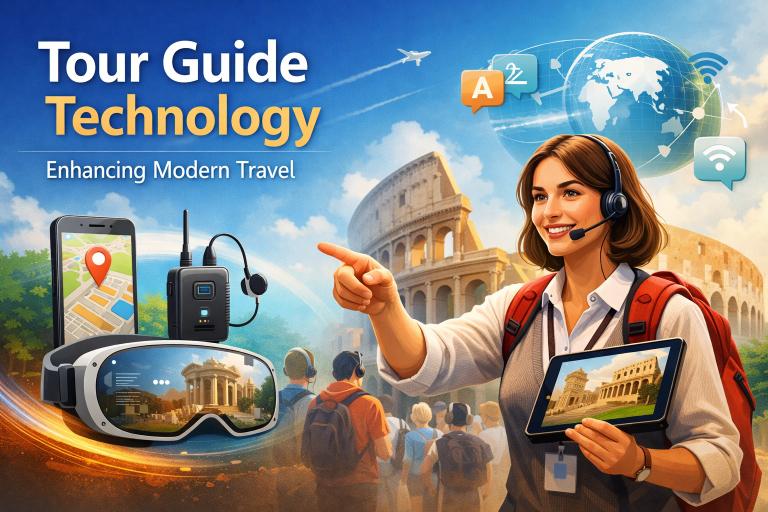
Travel has changed fast. Today, many people no longer want only a human guide holding a flag and giving long speeches. They want fast facts, maps on their phones, clear audio, and simple digital help. This is why many people now search for tour guide technology .
People often feel confused about what tour guide tech really means. Some think it is only audio devices. Others think it is just mobile apps. In truth, it is much more than that. It includes smart devices, mobile apps, GPS tools, QR codes, virtual tours, and cloud systems that help guides and travelers enjoy better trips.
Tour guide tech solves many problems. It saves time. It reduces mistakes. This makes tours easier to manage. It also helps travelers learn more without feeling rushed. Whether you run a tour business or plan trips often, this guide will help you understand what tour guide tech is, how to use it, and why it matters today.
How Tour Guide Technology Works
Understanding the technical foundation helps professionals select appropriate systems for specific applications.
Traditional wireless systems function through FM or UHF transmission. The guide speaks into a microphone connected to a belt-pack transmitter broadcasting audio signals. Participants carry lightweight receivers tuning into the designated frequency. Signal range typically extends 100-300 meters depending on environmental conditions and power output.
Digital app-based solutions leverage smartphone capabilities. GPS-triggered systems automatically play relevant content when visitors enter designated zones. Bluetooth beacon systems offer centimeter-level accuracy for indoor positioning. QR code systems give visitors control over when they access content. Cloud-based platforms enable real-time updates without requiring app reinstallation.
Modern hybrid systems integrate multiple technologies. A museum might provide physical receivers for visitors without smartphones while offering an app for tech-savvy guests. Both systems receive identical content, ensuring consistent experiences regardless of hardware choice.
Translation capabilities represent a crucial advancement. Multilingual systems allow guides to speak in one language while participants select from multiple translation options. Professional interpreters translate simultaneously, or AI-powered systems provide automated translation. Quality varies significantly—human interpretation delivers superior accuracy for complex cultural or technical content.
Tour Guide Technology – Quick Answer
Tour guide technology is the use of digital tools that help guides manage tours and help travelers receive information easily.
Traditional radio systems where guides transmit audio on specific frequencies to receivers carried by tour members.
Digital app-based solutions that deliver pre-recorded or live commentary through smartphones using GPS, Bluetooth, or QR codes.
Infrared and FM systems used primarily in fixed locations like museums and theaters.
Real-time translation devices that convert the guide’s speech into multiple languages simultaneously.
Examples:
- Mobile tour guide apps
- Wireless audio headsets
- QR code information boards
- GPS tracking for group safety
- Virtual and AR tour systems
The Origin of Tour Guide Technology
The term “tour guide technology” emerged in the late 20th century as electronic systems began replacing traditional guided tour methods.
First, the word “tour” comes from the Old French “tour,” meaning a circular journey or turn. Next, “guide” derives from the Old French “guider,” meaning to lead or direct. Finally, “technology” traces back to the Greek “tekhnologia,” combining “tekhnē” (art, craft) with “logos” (word, study).
Early tour guidance relied purely on the human voice. Guides shouted, used megaphones, or gathered small groups. The first significant technological advancement came in the 1950s with portable radio systems for factory tours. By the 1970s, museums introduced cassette-based audio guides.
Then, the digital revolution of the 1990s brought wireless headset systems. After that, the smartphone era introduced app-based solutions. Today, tour guide tech includes AI narration, augmented reality overlays, and real-time language translation.
No spelling differences exist for this term globally. Both British and American English use “tour guide tech ” identically. The consistency stems from the term’s modern origin, developing after spelling conventions stabilized.
British English vs American English Spelling
Tour guide technology uses words that stay mostly the same in both forms.
| Word | American English | British English |
|---|---|---|
| Tour | tour | tour |
| Guide | guide | guide |
| Technology | technology | technology |
There are no spelling differences in this phrase.
Which Spelling Should You Use?
- US audience: Use “tour guide tech ”
- UK/Commonwealth: Use the same spelling
- Global audience: Use the same phrase for clarity and SEO
Common Mistakes with Tour Guide Technology
| Mistake | Correction |
|---|---|
| Tour guide techonology | Tour guide technology |
| Tour guiding technology | Tour guide technology |
| Tour technology guide | Tour guide technology |
Tour Guide Technology in Everyday Examples
Email:
“Our company now uses tour guide technology to give audio tours.”
News:
“Museums adopt tour guide technology for contact-free visits.”
Social media:
“Loved this place! Their tour guide technology made learning fun.”
Formal writing:
“This study reviews modern tour guide technology systems.”
Tour Guide Technology – Google Trends & Usage Data
This keyword is popular in:
- United States
- United Kingdom
- Canada
- Australia
Searches increase during holiday seasons, museum upgrades, and city tourism programs.
Keyword Variations Comparison Table
| Keyword Variation | Usage |
|---|---|
| tour guide technology | Main keyword |
| digital tour guide | Similar meaning |
| smart tour guide system | Business use |
| audio tour technology | Device-based |
| virtual tour guide | Online tours |
FAQs
- What is tour guide technology?
It is digital tools used to guide and inform tourists. - Is it only for museums?
No, it is also used in cities, parks, and travel agencies. - Do I need internet for it?
Some tools work offline, others need internet. - Is tour guide tech expensive?
Many tools are affordable and scalable. - Can small tour businesses use it?
Yes, small operators benefit greatly. - Does it replace human guides?
No, it supports and improves their work.
Conclusion
Tour guide technology has changed how people travel and learn. It helps guides work faster, manage groups better, and give rich information without stress. Travelers enjoy clear audio, digital maps, and quick facts that improve their tour experience.
This guide showed you what tour guide tech means, where it comes from, and how to use it correctly. You also learned about common mistakes, real-life examples, and global usage trends. Whether you manage tours, run a travel company, or plan trips often, using tour guide tech will help you stay modern and competitive.
The key takeaway is simple: smart tools make better tours. Use tour guide technology to save time, improve safety, and give travelers a smoother and more enjoyable journey.